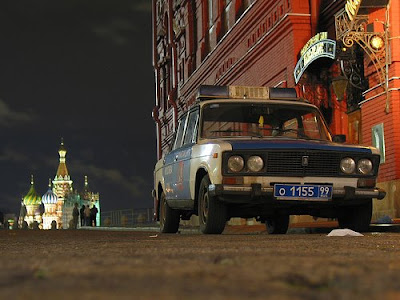
This site is our response to everyone who has ever asked us what Russia is like, and for anyone who might have never wondered, but should have. It’s an attempt to put into words Russia as we see it; our go at explaining that big old riddle wrapped in a mystery inside an enigma, that in fact, never went away. It’s about understanding the views, opinions and psyche of a nation that hits our headlines daily, without many of us ever really knowing why. And ultimately, it’s about providing a picture of Russia, as seen first-hand by two people, who think that although the journey they’re on to try and understand this country might never end, the process itself is worth sharing.


Showing posts with label Everyday Life. Show all posts

Sunday, 14 March 2010

Swedish Short Circuit

Image: Alexander Blosiak, openspace.ru

From IKEA’s Russian woes to maniacal cops on a deadly rampage, Andrei Loshak sees today’s Russia as a state of the absurd, a wonderland where Alice (the population) is up against the madness of the authorities. Both sides have been pushed to the edge, and both are beginning to snap.

----

Extracts from the article “Short Circuited” by Andrei Lokshak, full original version available on openspace.ru, translation by me (sorry for any mistakes).

State of the Absurd

“We were born to bring Kafka to life,” has been a famous saying since Soviet times. Submerged in the absurd since childhood, we Russians have become experts in it. From our position on the other side of the looking glass, we manage to get by despite it. And it’s only Europeans, with their tiresome rationalism, that arrive in Russia and immediately start trying to find a comprehensible logic in what is happening. But in the end most of them get used to the way things work here and some of them even start to obey the laws of etiquette that require that the cake is shared out, and then sliced up – the laws of the other side of the looking glass – Russian wonderland.

The Russian branch of IKEA is a perfect example. IKEA declared from the outset that even in Russia it intended to unwaveringly uphold its clear Swedish rules, based on a protestant work ethic and strict logistics. As a result, before the opening of IKEA’s first store in Moscow the local authorities cut off its electricity supply. For no practical reason whatsoever – just in order to “rough up” the company as payback for its excessive integrity. Ever since, the Swedes knew their stores were going to be needing their own generators and have tried to do everything in order to depend as little as possible on the mood of the local authorities. The store in Samara built three years ago has proven more problematic - the opening has been postponed nine times. IKEA, a company that has launched 230 stores around the world, just couldn’t break through the unflinching greed of the Samaran bureaucrats, whose last issue in a long line of grievances was that the building was “insufficiently hurricane-proof”. The Swedes, lacking any information about the destructive tornadoes that wreak devastation on the left bank of the Volga, finally took offence. The legendary founder of the company Ingvar Kamprad declared that investments in Russia would be curtailed. But it’s doubtful that such a scare will have any effect on local bureaucrats. For they act not in their own greedy interests. They support the normal functioning of an irrational system.

A few months later another blow was in line for Kamprad. It turned out that in using the generators – the idea that IKEA was so proud of – the company overpaid 200 million dollars, which practically reduced the profits of the whole eastern European division of the company over the past few years to zero. The Swedes thought themselves such Lancelots, having cut off the head of the dragon of corruption, but had forgotten that according to the laws of wonderland a new head quickly sprouts. An official investigation revealed that the Russian IKEA employee responsible for renting the generators had been receiving a cut from the leasers and had been significantly raising the cost of their services. IKEA cut its contract with this firm and as a result was fined another 5 million euros by the Russian courts for breaking the conditions of contract.

Then – the final blow. A couple of weeks ago the Swedish tabloids revealed that the director of IKEA for Russia and Eastern Europe, Per Kaufmann, famous for his public criticism of Russian corruption, had been turning a blind eye to evidence of backhanders being made to contractors of the regional administration. Kamprad stayed true to his principles and immediately sacked Kaufmann, who had been his closest colleague for the past 20 years. He admitted defeat. Maybe for the first time in his life. The Swedes repeated the mistake of land surveyor K in Kafka’s “The Castle”, who tried to conquer the absurd by the strength of reason. It turned out to be a crazy plan. The possibilities of reason are limited, but the absurd knows no boundaries.

Operating system

Corruption is irrational, as its very existence is deadly for a state. This is precisely why it ideally suits a state of the absurd, and is its operating system. The survival strategy for those living in such a state is not to look for the sense in anything. For those who dare attempt it, a glace at the Russian newsreel quickly turns into a psychedelic bad trip. A person will experience a cascade of dazzling negative emotions: fear, horror, shock, indignation, but meanwhile cannot find any logic: “Managers of the state bank VTB pulled off fraud, stole from the state and shareholders millions of dollars. One person has been fired.” , “Commander of the airborne forces of Russia General Shamanov will not be brought to trial due to no crime having taken place. The General tried to obstruct the work of a police investigator who was investigating a case concerning the General’s father in law, a criminal heavyweight who goes by the name of “Glyb”, for whom an international search warrant has been issued. The General called upon two squadrons of the air force special task force to deal with the police officer. The case has been closed because, as Shamanov himself explained, he later personally called off the order to capture the investigator."

It is the most Orwellian oxymora heard from the highest levels that are the final straw in the waves of paradoxical information and are enough to drive you insane: “conservative modernisation”, “sovereign democracy”, “parliament is not the place for discussions”. Such apparent contradictions are regularly thrown at our consciousness and heighten the feelings of disorientation and existential weightlessness which lead to a person being prepared to accept any information from above, however monstrous and contradictive it may be. As a result no one is even mildly surprised to hear that United Russia has won 102% in the elections. For what could surprise a nation where the title of main liberal democrat has been held by Vladimir Zhirinovsky for the past 20 years? The most ominous oxymoron of our time? “Law enforcement authorities”, in other words - organised crime. But, as strange as it may seem, it is precisely the police, in pushing the limits of moral decay, who can save the country. At some point in time the absurd, when it reaches critical proportions, transforms into outright nonsense, that is - utter insanity.

The State vs. the People

The turning point came with the massacre committed by Major Evsyukov. The shooting of shoppers in the supermarket didn’t just contradict common sense – it was devoid of it whatsoever. It was just after this massacre that the law enforcement went on the offensive against its own people. Every day we now hear about how someone in uniform has killed, robbed, run over in a car, or violated someone. For me, personally, what topped this all off was Evsyukov’s court case: “Former officer of the criminal investigation department of the district department of internal affairs Roman Potemkin, who participated in the arrest of Evsyukov, took a stand as witness. Potemkin was brought to court in handcuffs as he himself has been under investigation for extortion since October.” The collapse of the law enforcement system has actually already begun.

As is often the case, in the individual insanity of Evsyukov there was also the cast-iron logic of social processes. The system had to go mad. National security services in a healthy state, as Lenin once wrote, are steamrollers, unquestioningly carrying out the commands from above. As machines do not have and should not have brains, and commands are not given to them every day, their daily life is strictly regulated by instructions and rules. A malfunctioning occurs when commands from their owner dramatically contradict the rules of their maker. A short circuit occurs that causes over 2 million evil robocops to unleash terror against the civilians.

It’s strange – did the ruling elite really seriously assume that the law could be broken selectively? That whilst some carve up, squeeze dry, racketeer and topple the country, others, like complete idiots, will start to honestly carry out their duties under the social contract? This lie, taken to the absurd, has infiltrated the state apparatus from the top to the bottom, poisoned the heads of the junior and middle-ranking personnel. Our police force is now a massive army of bad lieutenants, ready at any moment to turn into insane majors.

People vs. the State

When the absurd grew into insanity the system hit the self-destruct command. The impenetrable fortress started to crumble from within. The eagle’s two heads are tearing one another to pieces and feathers are flying. But here’s the strange thing: the direr the state entropy, the faster everything falls apart and the easier it is to breathe. It’s as if there is now more air. I think that fear in society has disappeared. In the inability of the authorities to control their own kind the people have seen weakness. Such a state cannot have power to repress. The wild bites of the crazed system brought people out of their hypnosis. In the place of fear and apathy has come anger.

Mikhail Bakunin once wrote “Nothing is more dangerous for man’s private morality than the habit of command”. When the authorities start to degrade, you want to be higher than them, to counter cynicism with dignity, moral degradation with composure and humanity. The philosopher Murray Bookchin called this “self-organised reconstruction of society”. The vestiges of this process are already observable. Whereas before people only participated in public rallies when the bulldozers were already driving up to their house, now expressing protest has almost become fashionable. People have started standing up for one another. A couple of weeks ago a drunken police officer in a Mercedes ran over a woman standing at a bus stop. How did the officials act? The cop driving was incapable of stringing two words together; the man in uniform next to him hopped out of the car and ran off. Then their colleagues from the district department of internal affairs turned up and together with the road traffic police tried to sweep it all under the rug. How did people act? Three top bank managers who happened by chance to have seen the accident gave the woman first aid, called an ambulance, and when they noticed that the number plate was being unscrewed from the car, they called some journalists. It was only thanks to the noise they made over the matter that the public prosecutor found out about what happened. A scandal broke out. Heads went flying again (as if in their place new ones aren’t going to grow). A small victory was won over the system. The idea that a people deserves the government it has is a foul lie. At moments of great difficulty, simple people who have not been maimed by the “habit of command” don’t tear at each other’s throats, but hold out a hand of help.

As soon as the “steamroller” stops inspiring fear, out comes the age-old opposition of the Russian people to the state. The philosopher Berdiaev wrote, “Russia is the most un-governable country in the world. Anarchism is a characteristic of the Russian soul, it has been inherent in different ways both in the extreme left and the extreme right. Both the Slavophiles and Dostoevsky are also, essentially, anarchists like Bakunin, Kropotkin, or Tolstoy.” All imperialists and supporters of sovereign power in Russia are enemies of the people – and history just goes to show this. Our interests are diametrically opposed, “when the state gets stronger the people feebler” was the reverse dependency observed long ago by Kliuchevsky. Nothing has changed since. The popular teenage band “Lumen” sings, “I love my country so much, but I hate the State”. You couldn’t put it any better.

The most interesting thing is that those who work for the state are also anti-state in spirit. Just try talking to any cop or civil servant off the record. You’ll find more deception and cynicism than the classicists could ever have dreamed of. And the ruling elite similarly hides under patriotic rhetoric whilst carrying out its daily ritual of the absurd. As soon as the time comes they’ll scarper to Antibes and Marbella. They say that the Prime Minister’s daughters live in either Germany or Switzerland. In any case, not in Russia, that’s for sure. He’s no enemy to his own children.


... more

Thursday, 23 July 2009

All In It Together


Photo: still from 2008 French documentary Kommunalka directed by Françoise Huguier
It is the 1950s. You are in Moscow. You are walking through a series of rooms, all joined on to one another. In the first, a couple of kids are sleeping; in the second, a group of women are having their morning wash. You enter the kitchen, where a pair of matronly women are standing face-to-face, cooking porridge on identical, shabby stoves, before arriving at the final room, where you are greeted by an elderly man dressed in a white vest and black boxer shorts, merrily playing an accordion, as a pair of adolescent boys perform their morning exercises in the background. The man grins at you before setting off through the apartment, breaking into song as he goes. He is joined by the other inhabitants of the flat, a motley crew made up of men and women of all ages, ethnicities and backgrounds, who follow behind him, parade-like, dancing and smiling in his wake. Welcome to the kommunalka, as romanticised in Todorovskyi’s hit 2008 film, Stilyagi.

The kommunalka, or communal apartment, is one of the iconic symbols of the Soviet era. Dreamt up and implemented during the early years of the Soviet Union, the kommunalka, a pre-revolutionary, bourgeois apartment converted for mass living, was the predominant form of housing for much of the twentieth century. Ask most Russians above a certain age, and they will recall their early years, spent packed in amongst their neighbours, a group of people with whom they had previously had no connection, but whose lives they became to know in the most intimate detail: their dreams, failures, cooking and even toilet habits. The kommunalka was both pragmatic and idealistic, serving the dual purpose of solving the drastic housing shortage caused by rapid industrialisation, whilst simultaneously fulfilling the Bolshevik dream of abolishing that horrible bourgeois habit: private property. It was also hoped that the experience would help construct the new Soviet Man – a tolerant, selfless comrade, who thought only of the collective.

In the 1960s, Khrushchev sought to replace the much-hated communal experiment with individual housing. Large grey apartment blocks (the ones most westerners think of when they picture even modern Russia) sprung up across the USSR. Nevertheless the kommunalka was not to be thwarted and it persisted right up to the present day, still existing today, albeit in a diminished form.

Statistics for 2008 show that, in Moscow alone, there are still 58,000 functioning communal flats. This is a dramatic decrease from 1997, where the same survey showed 148,000, nevertheless it is still 58,000 more than you would see in any other non-ex-Soviet country. Earlier this year, Vladimir Putin promised to rid Russia entirely of the communal curse by the year 2014, a promise he evoked again last week when he stated that it was time to stop “encouraging the communal flat”. His renewal of the promise was in response to proposals that those living in unsafe housing in the Samara region could be re-housed in communal apartments. Putin was adamant that the communal flat was not appropriate in modern day Russia – an idea echoed by many. “In my opinion communal flats serve to humiliate the individual by always forcing them to limit themselves. Any indiscretion can lead to a scandal, if not an all-out fight. Sadly there are still far too many communal flats”, raged Yuri Shevchuk, who lived for ten years in a communal apartment, where he was accused on a daily basis of washing in dangerous chemicals by a paranoid elderly neighbour.

On the other hand, the kommunalka still has its supporters. As the opening sketch of Tardokovskyi’s film suggests, for many the communal flat retains a rose-tinted aura. In such accounts, the daily degradation of human privacy is forgotten and replaced with nostalgic reminisces of the all-in-this-together-folks variety: “I spent my entire childhood in a communal flat and, despite the lack of space, I don’t consider my time there a negative period… We had very friendly neighbours. What’s more I think the experience of living in a communal flat teaches you a valuable lesson in tolerance towards one’s neighbours”, recalled Nikolai Bordyuzha, General Secretary of the Collective Security Treaty Organization. Many recollections and memoirs similarly recall the comradeship between inhabitants, describing how, on receiving individual apartments, alongside the huge sense of freedom, people missed their former neighbours, continuing to see them and socialise with them on a frequent basis.

Where does all this leave the modern kommunalka? Despite an article in the trendy Afisha newspaper, pronouncing the birth of the ‘modern kommunalka’ – a small-scale, bohemian commune inhabited by arty types – for the majority of those living in Soviet-style communal apartments, the experience remains an ideal. It is almost unanimously agreed that in modern Russia, there is no place for communal living. Unless, of course, it is a lifestyle choice.

I’ll leave you with the sketch from Stilyagi and a link to an academic project charting the existence of kommunalki in St Petersburg. You decide which is more realistic.


... more

Sunday, 28 June 2009

A Year in Russia

Artwork: Viktor Pivovarov, "Bread roll to have with tea"
I’m back in England for a short while and it has given me the chance to reflect on the past year spent living in Moscow. Russia itself has certainly changed in this time, but I was wondering – how has it changed me?

The automatic reflex to put on my seatbelt as soon as I sit in the car has been completely lost. Not only do I no longer feel uneasy not wearing one, but when I do buckle up I feel my personal freedom is being compromised and worry that the driver may interpret such an action as a snub to his driving skills.

If the car I am in does not weave its way through traffic or drive flat out whenever possible I get impatient. The idea of undertaking or cutting someone up has faded from memory. For this same reason I now never attempt to cross the road without using the underground pedestrian crossing.

Although I still adamantly refuse to believe in “cross draughts” and their supposedly illness-inducing qualities I do now think twice before sitting with my back to an open window.

I only now realise why when I first started learning Russian the main thing we learnt all year was how to say “Russians like going to the forest and collecting mushrooms in their spare time.” And I like it.

Not only can I name all the countries in Central Asia but I can now tell an Uzbek from a Tadjik and a Kazakh from a Kyrgyz.

The pub has been replaced as my favourite hobby by going for a walk (“pogulyat”) and taking photos of myself and friends (“fotografirovatsa”).

Consequently, although I still find it amusing I no longer find it bizarre to walk through a park and for it to be full of girls in miniskirts and stilettos taking photos of themselves in compromising positions next to a tree or, say, writhing on the grass near some flowers.

In the same way, I never, ever have to ask myself the question: “Am I overdressed?”

I am no longer shocked or surprised to see fellow students at university with cheat notes up their skirts/sleeves/blatantly lying on the desk or shoving 1000 rouble notes in between the pages of their coursework before it is handed in (more on this in a separate post soon).

It now seems perfectly normal that my university professor’s mobile rings during a lecture… and he answers it… several times in one lesson... sometimes proceeding to have a conversation right there in front of the class. Although it’s still distracting, I no longer pay much attention to the fact that students also receive several phone calls during class and will get up to answer every time.

“Going for an Indian” has been replaced by “going for a Georgian” in my Saturday night out vocabulary.

My skin has become extremely thick against any type of abuse coming from a middle aged woman in a position of “authority”. My ears are deaf to her rants.

I cannot be sure that a rule exists unless I try breaking it. Even if I am ranted at by the above-mentioned middle aged woman in a position of “authority” whilst breaking this “rule” I still cannot be sure that there is a rule or whether she just wants something to rant about and thus I will continue doing whatever I am told I am not allowed to do in the expectation that she will quickly get bored and give up.

My English attitude towards queue etiquette has taken a rattling. Although I still often feel that my personal space is being invaded, I am no longer shocked when someone pushes right in front of me. I certain situations I find that it’s even me doing the pushing in.

I feel uneasy and self-conscious when my shoes are unclean. I feel like everyone on the metro is staring at the dirtiness and judging me.

I am not surprised to see policemen smoking, buying hotdogs, eating sweets and flirting with girls when they are in uniform and on duty.


... more

Sunday, 14 June 2009

Hello, Officer

Photo: einarorn on flickr.com
Yesterday I had my first run-in with the Russian police. Unlike many of my other foreign friends, I am not routinely stopped and hassled for my documents so this was my first direct experience of the renowned MVD, although of course I’d heard thousands of stories about how corrupt the Russian police are. This time around, however, I was definitely in the wrong, although I’m not entirely sure to what extent the police were in the right either.

Picture the scene. It was the start of a long sunny weekend and some friends and I decided to buy some wine and have a little drink in a park in the sunshine. Now, usually you can drink pretty much anywhere, anytime in Saint Petersburg, however we somehow hit upon the idea of taking our wine to the Summer Gardens, one of the few places where it is strictly forbidden to drink alcohol. We sort of knew it was forbidden, but this being Russia, where rules are made to be broken, we decided we’d probably be alright. So, we found a nice bench and after finding the requisite pieces of paper on which to sit (Russians have a peculiar horror of dirt and who knows what sort of diseases lurk upon benches) we poured our wine into plastic cups and started our evening. All was going swimmingly until a couple of policeman with joy in their eyes, descended upon us, shouting “you’re nicked!” (or at least the Russian equivalent).

Your Documents, Please

I suspect that the first lesson taught at Russian policeman school is how to ask for the documents of any law-transgressing (or potentially law-transgressing) (or indeed not Russian-looking thus potentially law-transgressing) character. It is perhaps the average Russian policeman’s favourite activity and they are at it everywhere: in the metro, on the streets, in the park, you name it. And so, true to form, we were asked to hand over our passports.

Not really wanting to do so, my Russian friends all immediately claimed not to be carrying theirs, whilst I stood there smiling stupidly, not having my passport with me and not really wanting to give away that I wasn’t Russian. The police, however, were adamant. No documents were produced at this point but we were told that it would be necessary to go with them to the station, to sort out this little problem. The police seemed remarkably happy about all this and didn’t in the least insist that we should pour the wine away. Instead, as we set off towards the station they told us to bring the wine with us, and so we we walked through the park drinking our illegal wine in their presence. They were also very cheerful, joking away as if it was all part of the picnic.

When we arrived at the station – a small hut/office in the park boundaries – we were told we would have to show our passports. In gallant, Russian-man style, my friend assured the police that the devushki (girls) hadn’t been drinking and so it really wasn’t necessary. Alas, the fact we were holding cups of wine somewhat negated this and the policeman insisted we show them. At this point I had to admit that I wasn’t Russian and unfortunately didn’t have my passport. To which the policeman astutely replied: “And how do I know you’re not a foreign terrorist?” Good question, to which I had no proof illustrating the contrary. He seemed to accept my promise that I wasn’t, but all the same made us go into the little hut, where a matriarchal mama of a policewoman sat looking at us severely.

“You do realise you are not allowed to drink in this park?” the woman asked. Well, yes. And then, the horrible fate that surely must arise from a meeting with the Russian police after such unlawful activity never happened. “Devushki, you must read these rules and then you can wait outside on the benches.” This was clearly a man's problem. And so Anna and I dutifully read the Park rules (which somewhat bafflingly included ‘no killing of swans’ despite a notable lack of swans in the park) and then went outside leaving the men to do their stuff. The men were offered a choice – 500r official fine per person, including noting down of passport information, or 300r under-the-table, straight in to the policeman’s pocket. A no-brainer really. The boys paid up as the girls waited quietly outside.

All’s Well That Ends Well

And so our police escapade ended. I learnt a few important things about how the police in Russia work: first, they really do love that little bit of money. The system of slipping the police a couple of hundred roubles and avoiding any further trouble is so entirely engrained in the minds of both the police and Russian citizens as to make it an almost officially sanctioned law. Second, when there’s a promise of some money the police are friendly. I mean, really, really friendly. Third, the Russian police are rather sexist. And for once, I was glad of it!


... more

Saturday, 30 May 2009

I live in Russia!

Picture: Film Poster for "Molodaia Gvardia"
Now the big raving Brit in me means that I have rather mixed feelings about England being dissed, especially when it includes having accusations of bourgeois-imperialism levelled at me. However, when it’s in a catchy song endorsed by a pro-Kremlin youth group and sung by one of Russia’s most notorious chanson artistes then I guess I can let it lie. “Ya zhivu v Rossii!” (I live in Russia!) is the latest single out by Sergei Trofimov and rather popular on the Molodaia Gvardia youth movement website. It won me over, see what you think:


(You can read by (very badly translated) transcript of the lyrics in English below. If anyone can do any better you are more than welcome!)

Somewhere in London it’s been pouring with rain since the morning
Pavements, streets worn out by cabs
You won’t find any place in the pubs, and on the stock exchange,
The game turns into the usual British gambit

The order of things here is unchanging and simple
Like the parliamentary throne of the Queen
And the influential pound continues the rise
Of the bourgeois-imperial tree

*** Chorus ***

But I live in Russia!
At the furthest point of being
I live in Russia!
It’s simply my motherland

In this untamed great power
Constrained by dreams of days gone by
It’s unlikely that life will become more substantial or simpler
But it’s my home

***

On the Saint-Claire Boulevard chestnuts are flowering
And in the Boulogne forest the cold wind has gone astray
And the glass turns red from Burgundy wine
As if the Holy Grail has been discovered again

Here a united people respect themselves
And their freedom attained through suffering
And they live from day to day, not bemoaning anything
Earning a profit from goods from year to year

I had a friend, he went away a long time ago
To that place which did not have shocks and misfortune in store
For him, our life is like a bad film
Where the budget can’t save the mediocre plot

Sometimes he calls to find out how things are going
And, having heard the latest gossip
Doesn’t understand why we are burning to the ground
In order to once again rise from the ashes


... more

Friday, 29 May 2009

News from the Caucasus

Photo: Sergei Maximishin, Kabardino-Balkaria
Russia is the biggest country in the world. Fact. And it’s with this in mind that I’m going to start blogging more news from the more far flung regions of the motherland. In the days to come I’ll be taking a look at the Russian Far East, Siberia, the Urals, who knows - I might even make it to Murmansk. But for now, I’ll start where I left off on Wednesday – down south, in the Caucasus.

Kavkaz-uzel.ru is an internet news portal for the Caucasus region with constant updates on breaking news stories. I read through the news posted over 24 hours yesterday and picked out 3 stories to tell you about.
___________________________

A Gun Battle has Broken out in the Capital of Kabardino-Balkaria
May 28, 3:35am

The sound of explosions and gunfire can be heard in central Nal’chik, capital of Kabardino-Balkaria, near to the central market and bus station.

“Law enforcement officers have blocked militants into a privately-owned building on Mechnikov street,” explained one source.

The shootout in central Nal’chik started at 1:30am Moscow time. At the current moment single gunshots can be heard.

The situation in Kabardino-Balkaria has again escalated. On the night of the 10th of May in the village of Dugulubgia after a special operation by the FSB three fighters were killed. According to unofficial sources, one of those killed was later identified as a former Imam of the Kabardino-Balkarian Jamia, Mussa Mukozhev.

On the 14th May the vice chief of the pre-trial detention facility of the federal penitentiary service Vitalii Bogatyrev was shot dead nearby his home and 500m from his workplace, by a gunman in a passing vehicle.

On the 20th May in Nal’chik gunmen opened fire on traffic policemen in a police car. The policemen returned fire but the gunmen managed to get away.

****

Markov: strengthening Abkhazia’s border with Georgia will ensure security
May 28, 9:11am

Reinforcing the border between Abkhazia and Georgia with Russia border guards will allow a higher level of security for Abkhazia to be ensured, will improve the economy and raise the number of tourists to the region declared Sergei Markov, MP.

According to the Markov, the Georgia’s government, under President Mikhail Saakashvili “has not let go of the idea of bringing Abkhazia back under control by force.”
The agreement signed on the 30th April to guard the border between Abkhazia and Georgia with both Abkhazian and Russian border guards is “legal, obvious and expresses the interest of the peoples of Russia and Abkhazia” declared Markov. “The border guards not only guard the border but also create the conditions for peaceful work and development of the people of Abkhazia.”

On the 1st May NATO declared that the agreement with Abkhazia and South Ossetia on guarding their borders is in conflict with the agreements from the 12 August and 8 September and is not conducive to long-term peace and security in the South Caucasus.

Markov also mentioned that he had been involved in the preparatory stages of a expert-youth forum that will take place in Abkhazia in July with the participation of “United Russia” [Russia’s ruling party], “Young Guard” [a pro-Kremlin youth group], students and professors from Russian universities and Russian experts.

****

Preparations continue in Chechnya for the municipal elections
May 28th 2009, 13:34pm

Preparations for Chechnya’s municipal elections which will be taking place on the 11th October are currently underway. They are being taken particularly seriously due to the fact that this is the first time that municipal elections are being held. The regional Central Election Committee is undertaking a lot of work preparing brochures as well as seminars to ensure that voters, candidates and the media understand the election process.

Observers have expressed scepticism with regards to the results of the voting in the parliamentary elections that took place on the 12 October 2008. What bothered them in particular was the unconditional support shown by the population towards “United Russia”, the leading party that received 88.4% of the votes.

Meanwhile, the voting situation for two contested regions remains unclear. Sunzhenskii and Malgobekskii are currently under the jurisdiction of Ingushetia, but before 1934 were administrative parts of Chechnya. Chechnya’s head of parliament has previously made clear that the status of these regions need to be decided in a fair manner. However, there are no documents other than those from 1934 that determine whether these two regions belong to Chechnya or Ingushetia. Official commissioner on Human Rights to the Chechen Republic Nurdi Nukhazhiev has also declared that Ingushetia does not have the right to lay claim to Chechen land. Nevertheless in recent times the question as to the status of Sunzhenskii and Malgobekskii has not been raised.


... more

Sunday, 24 May 2009

Meet the Gopniks

Photo: okya1.ru
A group of young men wearing pointy-toed leather shoes, gold chains and shiny tracksuits with fake brand names – think Abibas not Adidas - squat around a mobile phone that blares out Russian techno, chewing on sunflower seeds, drinking beer and occasionally spitting massive gobs of phlegm to display their manliness. Meet the Gopniks, a so-called youth sub culture (although no one would ever actually describe themselves as a gopnik) of young, not-very-well-off, Russian men.

It is impossible to live in Russia very long without hearing about the gopniki: newspapers, blogs, even my friends, talk constantly about them, but exactly who they are is a bit of a mystery to me. Gopniki.net , an online ‘museum’ of gopniks providing a cod-anthropological expose of the group, gives the impression that they are a defined criminal group, whilst another site describes them as 'a post-Soviet subculture educated in the criminal aesthetic and brought up in a working environment.'

And yet my friends' use of the word 'gopnik' is far wider: anyone from the working classes, who seems to be getting a bit lairy or causing a bit of a trouble can be classed as a gopnik. Could it be that gopnik is the Slavic equivalent of the British chav? Is that even possible in Russia, a country which apparently doesn't sh
are Britain's complex system of class snobbery, as epitomised by the much-debated division between chavs and chav-nots?

The exact origins of the term ‘gopnik’ are unclear, although it is generally agreed that it comes from the addition of the suffix –nik to the acronym GOP. However to exactly what GOP refers remains a contentious issue. One version has is that it stands for Gorodskoye Obshchestvo Prizreniya (the City Society of Care), the name for the network of poor houses set up by the Soviets following the October Revolution. Another version translates the acronym as Gorodskoye Obshchezhitiye Proletariata (The City Hall of Proletarian Residence), referring to a large hostel set up in the 1920s in Saint Petersburg in the Hotel Oktyabrskaya, to house the tidal wave of peasants and small-city dwellers that flooded into the capital during the chaotic dislocation of the post-revolution years. According to Petersburg folklore, the once-grand hotel soon became became renowned as a hubbub of criminal activity although historians have never been able to find proof of it’s existence.

In any case, whichever acronym GOP refers to, the term gopnik evolved as a word to describe poor young men, whose backwards ‘provinciality’, criminal behaviour and general loutishness conflicted with Soviet rhetoric, which called for ‘culturedness’ - a value reaching far beyond our western perception of culture, encompassing certain standards of behaviour such as abstinence from alcohol, traditional sexual morals and a smart and clean appearance. Throughout the Soviet years, the term gopnik was invoked as an insult to those on the margins of society, who drank, committed crime or were just generally considered uneducated and uncultured.

The term gopnik survived the collapse of the Soviet Union and throughout the 1990s it evolved to refer to the hard men who reigned throughout this lawless period – the reason why most Russian flats have at least three locks, as gopniki, shaved-headed heavies provided the muscle in business and politics. During the 1990s gopniki had power, if not respect, as they raked in money by any means as many, more educated Russians suffered from the fall out of the Soviet Union and the difficulties of adjusting to the free market.

With the demise of Yeltsin and the implementation of Putin’s iron hand and with no strong cultural yardstick a la Soviet culturedness, it looked as though Gopniki as a social subgroup could be over. Indeed, when a couple of years ago a group of journalists from Exile magazine went on a ‘gopnik’ safari they concluded that the gopnik movement was as good as over: Just as the mighty Tyrannosaurus Rex evolved into the rock pigeon, right before our eyes we're witnessing the rapid devolution of the gopnik into something that can only be described as "skinny dude with a bad mullet who tells everyone he's a brand manager but for now he works at a Evroset kiosk where he managed to five-finger enough cash to get himself a used Nissan Almera, which he loves more than anything which ever was, is, or shall be." And so from a feared group of fairly hardcore criminals, the gopniki have become a mocked group of not-very-wealthy Russians. Gopnik has become a cult idea, spawning books, music, the works... Take a look at this clip by Syava, a rapper who parodies ‘Gop Hop’ artists (think Goldie Lookin’ Chain meets the Russian Provinces) a current you tube sensation.

The label ‘gopnik’ is assigned to anyone of low income and low education, who, in the eyes of society, don't have the nouse to sieze the opportunities available to them in society. Today's Russian gopniks are no different to England’s chavs or America’s white trash: they are not a cultural sub group – indeed, they can not even be defined as one group - but a reflection of social snobbery very much alive in Russia today.


... more

Wednesday, 13 May 2009

The Treats, Trials and Tribulations of the “Taxi”

Photo: "Lada in Belarus", carolinephotography.co.uk
There’s no better way to experience the delights of the Russian automobile industry than by hailing a “taxi” on the streets of any town or city of Russia. In the short period of time that it takes you to journey to your destination you are free to admire the finer details of various car models the likes of which are unseen and unheard of (for good reason) in the West. During this time you will also experience a momentary insight into the life of those who drive such a vehicle. Trapped in a confined space with a total stranger for whom you have momentarily become a long-time friend, you are unable to escape hearing his whole life story / personal reflections on the financial crisis / evaluation of the state of the country and/or world today / extensive opinion on immigration / complaints about the price of groceries and/or government pension schemes.

The most convenient thing about taxis in Russia is that most drivers are potentially ready to become one. Stick out your hand and negotiate your price and destination with the first person who stops. If the first car does not fancy this price/destination combination fear not – there’s probably already a queue forming behind him waiting to get their chance. This standard practice of negotiating your price with the driver beforehand niftily saves you from the agony of the London black cab as you sit watching the little red figures on the metre rise exponentially every couple of seconds and is one of the main reasons why I am a fan of the “gypsy cab”.

The ubiquitous Lada “Zhiguli” model (yes, it’s the one whose inventors were clearly inspired by the cars they drew in crayon as children) in various states of disrepair or, more comically, with tinted windows, shiny hubcaps and leopard-print furry seat and steering-wheel covers is the first “taxi” that you will probably come across. My favourite Zhiguli experience so far (and there are indeed, many) was one with a tinted rear windscreen etched with a line drawing of Tyra Banks running through a forest accompanied by wolves. The driver really didn’t look the type. Indeed, whilst hailing a car, although it is easy to pick out from a distance which car in the line of traffic will be the one for you (bets are on that it won’t be the guy in the Mercedes), predicting the conversation in store is more of a refined ability.

The price of your journey will depend on various factors, including whether the driver is going that way anyway, how small his normal wage is, how keen he is to have someone to rant at, whether you can show them how to get to where you’re going and how direct the road is. If your destination is straight on then you’re in a good position to negotiate. If your destination is to the right then, at least in Moscow, the city where it is impossible to make a right-hand turn, getting to where you want to go will involve 3 left hand turns and/or u-turns and so your price is likely to be higher. In any case, you can be sure that you will get from A to B in the fastest possible time by weaving in and out of traffic, tailgating the car in front, or even better, tailgating an ambulance passing through a red light. Don’t be surprised if you driver tells you that you don’t need to put your seatbelt on when he sees you making an attempt to do so. Don’t be surprised either if he sees any attempt at putting on a seatbelt on as a personal insult to his own driving abilities. And don’t be too surprised if your car happens to have a portable police siren stuck to the roof. It’s all part of the experience.


Putin: Good Evening, will you take me to the Kremlin?
Driver: D’you know the way?
Putin: Not really, I’m from Petersburg myself.
Driver: How much you payin’?!
Putin: I don’t know… 200 rubles?
Driver: Call it 300 and let’s go.
Putin: No, I won’t pay 300 sorry
…
Driver
: Alright then, let’s go.
Putin: Excuse me, can you…?
Driver: It’s alright… I’ve got one myself.


... more

Wednesday, 6 May 2009

News from the Eastern Bloc

Artwork: Sinie Nosy
What would happen if Eastern European countries had Facebook accounts and updated them as much as the average British student with an iphone and a yearning to share their every feeling with the outside world? Radio Free Europe tried to imagine the result and this is what they came up with for this week. Love it!
____________________


... more

Saturday, 2 May 2009

Saving for a Sunny Day

Artwork: "Garden", Asya Nemchanok
The economic crisis is taking its toll in Russia, yet people are keeping faith and the authorities will not let a looming budget deficit get in the way of a sunny Victory Day parade. Well, at least that’s what the “Russia in Figures” section of this week’s Vlast magazine seems to indicate.
__________________

According to the Russian Home Office, on the 19th of April (Orthodox Christian Easter Day), an Easter church service was held in 9,300 churches across Russia with a participation of approximately 4.5 million people and an extra 106,600 thousand police officers on duty (or one extra police officer for every 42 people). Between 60 to 70 per cent of Russians consider themselves Orthodox Christians (85 to 99 million people), of whom 1 in 19 attended an Easter service.

Compare this with Christmas church-going. On the 7th of January (Orthodox Christmas), 2.1 million people (or one in 40 of those who consider themselves Orthodox Christian) attended a service at one of the 8011 churches open that day. An extra 85,700 police officers were on duty. This means that at Easter 2.4 times the amount of people attend Church than at Christmas. The proportion of police officers to visitors however is 1.68 times higher at Christmas than at Easter, leading the writers of Vlast to conclude that Easter is celebrated more widely in Russia than Christmas, but rather less riotously.

15,280 rubles [£310 / €348 / $462 by today’s exchange rate] was the average income in Russia for March of this year. This was 13.3% more than in March 2008.

According to Alexei Kudrin, Russian Finance Minister, the Reserve Fund of the Russian Federation [Note: which peaked in January 2008 at $157 billion] “will be practically completely run dry” by 2010. On the 1st of April 2009 the fund was still over $121 billion in the black.

Inflation over the period from the 1st of January to the 20th April 2009 stood at 6%. This is the same as over the same period last year.

The Moscow authorities will be spending 65 million rubles [£1.3 million / €1.48 million / $1.96 million) this year on cloud dispersal treatments for the 9th of May Victory Day celebrations and Moscow City Day celebrations [Note: on important bank holidays planes are sent up around Moscow to disperse the clouds and to ensure sunny weather. Boris Johnson should really take note.]

2,700 kilometres of road will be built in Russia in the upcoming year, which is 17.4% more than last year.

2.26 billion people were registered unemployed by the 15th of April – 1.6% more than the amount registered by the 9th of April. According to official statistics since the beginning of October last year 329,000 people have lost their jobs.

The foreign trade turnover of Russia in January and February of this year stood at $50.5 billion – only 56% of the turnover taken during the same period of last year. According to official statistics exports stood at $36.7 billion (52.3% of last year’s amount) and imports at $23.8 billion (64.5% of that of last year).

The price of medicine rose 14.2% in the January to March period of this year in comparison with prices in December 2008.


... more

Wednesday, 29 April 2009

Sparkling Socialism

Ickily sweet, bubbly and dirt cheap, no Russian celebration would be complete without the obligatory bottle (or two) of Shampanskoe, Russia’s answer to the rather more famous and – dare I say it, more palatable – French Champagne. There are many, many different varieties available in Russia today, but, beyond a shadow of a doubt the most popular is Sovetskoe Shampanskoe, available in various degrees of cloying sweetness – Brut, Semi-Dry, Semi-Sweet and Sweet – all at less than three pounds a pop. The product’s black and gold label is so ubiquitous that I assumed it had been around for years, however it was actually only in 2004 that it became a registered trademark. Nevertheless, the story of its creation is a good one, reaching back to beyond the 1917 revolution and stretching on right up to today.

Champagne (which, due to EU licensing laws that restrict the application of this title to products made in France’s Champagne region, we should technically call 'sparkling wine') first appeared in Russia during the eighteenth century. It wasn’t until the turn of the twentieth century, however, that production really took off. Prince Galitsyn, a Belarusian aristocrat, garnered international acclaim when his version of the fizzy drink, produced on the shores of the Black Sea in Abrau-Dyurso, won the Grand Prix de Champagne at the Paris World Fair in 1900, beating off stiff competition from the French Champagne region itself. Russian-produced Champagne, Russkoe Shampanskoe, quickly became a symbol of prestige and the high life – an example of how Russia could produce luxury products on a par with France, whose culture and way of life were so esteemed by the Tsarist court.

Then the Russian Revolution arrived, aiming to sweep away the injustices and excesses of Tsarist luxury and, along with it, champagne, which was clearly somewhat lacking in proletarian credentials. For the first ten years or so of the Soviet period, a puritanical aesthetic reigned as party loyalists attempted to purge the country of Tsarist era inequality. At a time when Communist Party officials dressed in grey overalls and stark leather coats and simply wearing a snazzy jacket was enough to incur the title ‘bourgeois’, which would likely lead to swift deportation or worse, it looked like this could be the end for Russkoe Shampanskoe.

But then something remarkable happened during the 1930s. In 1934, just one year after the Ukrainian famine during which approximately five million people starved to death, Stalin announced that the time had come to bring cultural and material prosperity to USSR. In an infamous speech, in which he claimed, ‘life has become more jolly!’, Stalin spelt out the new guidelines for Russian socialist society. No longer would people live by the principles of self-sacrifice and abstinence; the time had come to celebrate the gains of socialism. If capitalist societies could provide for their citizens, then surely the Soviet Union, with its vastly superior system of production and distribution, could too. Moreover, in contrast to their capitalist counterparts, luxury goods would be available to all citizens, not just a privileged few. And what better way to toast this new life style than with a glass of Soviet-produced Champagne, the ultimate symbol of the high life?

And so the party apparatchiks turned their attentions to the mass production of Sovetskoe Champanskoe. Under the watchful eye of the Minister of Trade, Anastas Mikoyan, Prince Galitsyn’s former employees were put to task creating a widely available Soviet variation of champagne, which they achieved by altering the fermentation technique so that champagne was made in small reservoirs rather than bottles. In 1937 the first bottle of mass-produced champagne popped off the conveyor belt – now everyone could enjoy the (achingly) sweet taste of champagne.

Of course, whilst in theory champagne was now available to everyone, things in the Soviet Union rarely occurred as they were officially described. Throughout the Soviet period a two-tier system existed, whereby those with connections could enjoy access to goods, whilst the majority went without. Certainly, champagne did not immediately appear on your average Russian’s table. Nevertheless, the widespread availability of champagne had a certain propagandistic appeal – Look! We give our citizens the best of everything – meaning that the authorities did their best to make sure everyone could experience it. Indeed, following victory in WWII, Stalin decreed that the people of Russia should celebrate with a glass of Sovetskoe, and by-and-large, they did. And so from herein, from 1937 right up to collapse in the 1991, champanskoe remained predominately available. Bizarrely, as queues built up for arguably more essential items (bread, potatoes, milk), champagne continued to be produced.


When the Soviet Union fell, Sovetskoe Champanskoe remained the generic label for any sparkling wine produced in Russia and a prerequisite for any wedding. In 2004 the name was bought by a state owned company and to this day if you ask for a glass of Shampanskoe, any barman will know exactly what it is you have in mind.

... more

Tuesday, 21 April 2009

Stalinists vs. the Truth

Photo: Danil Golovin
Last week an article by Igor Chubais, academic and estranged brother of Anatolii Chubais, (prominent businessman and politician known for being the chief orchestrator of the economic “shock therapy” privatisation of the 1990s), was published in Nezavisimaia Gazeta, in which he expressed his opinion on the recent controversy surrounding proposals made by government minister Sergei Shoigu to bring in a law that, much like laws banning holocaust denial, would make denying the victory of the Soviet Union in the Second World War a punishable offence.

Shoigu’s suggestions created quite a controversy in the Russian press, with many observers seeing an attempt to eternalise the “victories” of Stalin, who is highly credited for leading the Soviet Union to victory in the Second World War. Chubais, among others, sees something more than this however. In his opinion, the law in question is not, as it may seem at first, a means of glorifying Stalin, but rather a way of preventing the revelation of the “truth”. This truth can be found in the recently published memoirs of Nikita Khrushchev, which disclose that amongst the Soviet political elite it was a well-discussed fact that had the USA not joined the war effort when they did, the Soviet Union would never have stood up to the German onslaught and would most certainly have lost the war.

The Soviet Union, despite its massive army, was pitifully prepared and led, consequently losing almost 27 million citizens (nearly 14% of the population) during the course of the war (compare this with approximately one million lost by the UK and France combined), most of which need never have perished. In considering the needless losses on the Russian side it suddenly becomes much more difficult to speak of victory and makes the war look significantly more like a national disaster.

This, according to Chubais, also makes Stalin one very ineffective leader. And ineffective leaders in Russia still abound to this day. The law banning denial of the national victory therefore has a much more contemporary significance. At the same time as Russia is witnessing the rebirth of the cult of Stalin due to media manipulation and new school textbooks presenting Stalin in a more positive light, the country is also witnessing the rebirth and re-emergence of an ineffective neo-Stalinist leadership. The law is therefore not just about glorifying Stalin, but about legitimising Russia’s ruling elite of today.

As a direct result of today’s ineffective leadership, Chubais notes that Russia’s main problems are now:
  • Not low birth-rate (it is in fact higher than in the West), but rather an
    excessively high death-rate and the gradual extinction of the Russian nation
    (and that’s without even mentioning the 4 500 000 homeless);
  • Not a global economic crisis, but rather an economy that is incapable of
    developing as it is suffocated by bureaucracy and corruption;
  • Censorship, insufficient research in social sciences and decomposition of
    the education system;
  • An unbelievably low quality of life in the richest country in the
    world;
  • An oppressive atmosphere of apathy and amorality sown by television;
  • A counterproductive foreign policy that has left the country with neither
    friends nor allies.

And here Chubais again quotes Khrushchev in his memoirs; “Stalinists are today painting Stalin as a genius and a great leader, and this is most dangerous. They are, intentionally or unintentionally, not only covering up the crimes which have been committed, but also opening up the future to the use of the very same methods used by Stalin himself.” Put in today’s context, the only way to break out of this vicious cycle of ineffective leadership and to put Russia on the right track for the future is for the Russian ruling elite to publicly condemn Stalin and thereby enable a distancing of the methods of leadership that are continuing to create needless losses in Russia to this day.


... more

Sunday, 19 April 2009

From Russia... with Love?

Photo: Evgenii Karmaev. "To the finest and most charming girl ever, with wishes of happiness."
Vlast’ magazine’s question of the week “Does the world love Russians?” gave rise to an interesting array of opinions from respondents. Here’s what some of them had to say:
___________________________________

Dmitri Rogozin, Russian Ambassador to NATO
By my observations the world loves Russians less than Soviets. Even back then, the word “Soviet” was met with more sympathy in the West than the word “Russian”. Ballet – Soviet, cinema – also Soviet. Rather than creating optimism that the meeting will be productive, “Russian” sets off the warning signs in the minds of Europeans and Americans.

Mikhail Margelov, Chairman of the Federation Council Committee on International Affairs
It all depends on how we behave ourselves abroad. If we behave like Europeans, then they love and respect us; if we behave like newly enriched natives of a third world country, then they look down their noses at us. In the early 90s a friend of mine, on holiday in Thailand, asked some businessmen about their impressions of Russia. They replied “The Absolut was always cold, but we never set foot outside.” With such behaviour we deserve neither love nor respect.

Pavel Bure, Ice-hockey player
We are not loved, but we are respected and that’s the main thing. Russia is a strong country, everyone respects our opinion. The Americans are now intending to reset US-Russia relations - they understand that it’s long since been time to get working positively together. We will deal with the financial crisis quicker if we work together.

Georgii Boos, Governor of Kalingrad Region, Russia
Normal people all over the world love Russians, and politicians and businessmen respect us. Russia is a strong country; we are the West’s competitors and that’s why they don’t let our businesses onto their markets.

Ralif Safin, Federation Council Minister
The world both loves us and fears us. They started to fear us after the fall of the Soviet Union. When we turned up in the West we were uncivilised and rude; we thought we were so great, but were incapable of saying hello politely; couldn’t speak any foreign languages; never opened doors for women… They still fear us now because they know what kind of revolutions we start. But they love us all the same for our big hearts and souls.

Efim Malitikov, Chairman of the Intergovernmental Committee of the Commonwealth of Independent States for Spreading Knowledge and Adult Education; General Consultant to the UN
I don’t think they love us, but exploit us - for Russians are very talented and support the economies of leading countries. They don’t love us because God gave us the ability to adapt to anything. In Britain and in America our emigrants have high-level positions in the economic sphere and this makes them jealous. Moreover, our country is big and powerful, with massive natural resources. Many would like to be in our position. They don’t love us because Russians can go to war or to work not for money but for ideas.

Leonid Zamiatin, Soviet Ambassador to the United Kingdom 1986 – 1992
What do we need to be loved for? We need to be respected. They didn’t love the Soviet Union; they were afraid of it due to its massive nuclear capabilities. In the 1990s we sold that all away in return for metallurgy. But we need to do everything possible so that our opinions are respected, not so that we get showered with compliments. We should clearly lay out Russia’s stance on the issues of creating a world currency and taking cooperative action against terrorism and drugs from Afghanistan. We need to clearly specify where our interests lie.

Marina Bukalova, Managing Director, Airline Company Sky Express
The world is wary of Russians because in the minds of people in the West, a Russian is still someone in a fur hat and paralytic drunk. They don’t love us because Russians are unpredictable, impulsive, brave and a lot more talented than others. No-one likes a competitor. This is compounded by the fact that Russians don’t know themselves, and people are scared of the unknown.

Lilia Chekhover, First Secretary; Embassy of Israel in Russia
In Israel Russians are very much loved. We have a lot of immigrants from Russia and the USSR and strong cultural links. We highly value works by Tolstoi, Pushkin, Lermontov. We remember how much the USSR did for the formation of the Israeli state.

Anzori Aksent’ev, Businessman
What love can you talk about when even our closest brothers – Georgia and the Ukraine have turned away from us? He who is loved is not left alone. The West doesn’t love us because it sees us as competitors. The East traditionally respects us. Of course sometimes they don’t like us for unsubstantiated reasons - the US has been refusing to grant me a visa for years, accusing me of god-knows-what. It’s the same for any Russian citizen. The 22,000 warheads our country is armed with however can only be a cause for respect.


... more

Sunday, 15 February 2009

Village People

Photo: carolinephotography.co.uk
Living in Moscow it’s easy to forget that for much of Russia’s rural population who do not live in the excesses (or simple adequacies) of the country’s capital, life in the 21st century has not yet begun. A friend and I spent a night living like locals (well, almost) in the Siberian village of Tashtagol and understood rather quickly how male life expectancy out in the sticks of Russia can average as little as 46 years in the worst regions.

---- ---- ---- ----

The plan to stay at the datcha for three nights doesn’t get off to a good start. “Firewood’s in the barn and the toilet’s over there,” says Andrei, the next door neighbour enlisted to help us out, nodding over at a small wooden hut around 20 metres away yet separated from us by untouched snow nearly 6 foot deep. “You’ll have to dig your way over,” he adds, with a chuckle. I have other priorities in mind - the temperature outdoors is minus twenty something and although the stove is doing its best, indoors it is still averaging a good ten degrees on the wrong side of zero. “How cold is it forecast to be tonight?” we ask tentatively. “Ooh, around minus 48 I should think,” is the unwelcome reply. I hope that is a rural Russian joke.

Left to fend for ourselves and having quickly assumed traditional gender roles Johann is shovelling snow to clear a path to the barn outdoors and as the female hunter-gatherer I pay a passing motorist to give me a lift to the local shop to buy supplies for the night. Admittedly, had I been true to my Russian villager role I would have braved the wait for a bus, but then my English feet are freezing and my English patience exhausted. My groceries, however, are decidedly “local” (in ‘the League of Gentlemen’ sense and admittedly not out of choice); some dubiously-looking sausage, cheese, black bread, a pot noodle and some instant smash.

On my return it’s already dark outside and the hut has heated up to a tropical minus two; I even have a go taking my coat off. In preparation for the night ahead Johann does some frozen wood chopping and does his best to fill a bucket, which is more hole than bucket, with some frozen coal. Our supply of frozen wood and frozen coal does not fill one with optimism. The buckets of water collected earlier from the village’s only tap have begun to freeze over despite being next to the stove. So has the water that has emptied straight onto the floor from a hole in the sink and that has collected near the entrance. My ideas of a steamy-hot banya and hot chocolate in front of a roaring fire are gradually being replaced by a somewhat colder reality.

Having eaten a dinner of all the above-mentioned ingredients fried together in a pan, exhausted any frozen wood chopping opportunities and even having stomped our way through shoulder high snow to the outside loo, we find ourselves at 6pm and at a bit of a loose end. With no transport, and nowhere to go to in the near vicinity even if there was, we quickly understand the allure of drinking oneself into oblivion and thus the crux of Russia’s rural demographic crisis. Hacking at the ice that has formed around the entrance provides some brief entertainment but we’re freezing in bed by 8pm; the thermometer inside our hut is has reached two degrees. Hourly efforts at keeping the stove alight prove futile; our two degrees Celsius average doesn’t get any better. By morning we decamp to an apartment in town – I’ve already had enough of the “real” Russia.

The most surprising thing about this experience was not our complete ineptness at keeping a stove lit, nor my reluctance to use an outside loo in subarctic conditions but rather the fact that 27% of Russia’s population of 140,000,000 live in rural areas with many in conditions largely similar to that from which we had quickly fled. In Abakan and Krasnoyarsk, two other Siberian cities we visited, just outside the city centre one finds clusters of these traditional wooden houses, which, despite being so tantalisingly close to civilisation have sporadic electricity supplies and no access to running water. Moreover, a large proportion of those living in such conditions are not sturdy youths who can chop wood and fetch buckets of water with relative ease, but the older generation who have nowhere else to go – living in rural poverty since time immemorial, excluded from the Soviet Union’s modernisation drives, brushed aside under capitalism and condemned to an existence below the breadline.

Such impoverished living conditions for so many of Russia’s citizens have clear implications for the country’s pretensions to superpower status on the world stage. The facts are contradictory; a member of the G8 that is, in parts, a third world country. A UN report published in 2006 presents some sobering statistics; the poverty rate in Siberia averages 35%. In one district this was as high as 77%. In another, nearly 16% of housing was classed as being in dilapidated or dangerous state of repair. Progress has been made over the past ten years yet many households remain excluded. The future prosperity of the country as a whole depends on lifting the most backwards areas into the 21st century and providing running water to rural communities is one of the important tasks that Russia faces today.


... more

Wednesday, 21 January 2009

Chocolate Alenka

Photo:www.romantiki.ru
As pretty much anyone who has ever read a newspaper will know, Russia’s main exports are industrial: gas, oil and other natural resources. Exportation of domestic goods is rare – ask most Westerners to name five Russian domestic goods and they’ll probably struggle. After Baltika and perhaps the odd obscure brand of vodka, they’re likely to draw a blank. Nevertheless, Russia’s homegrown food industry is thriving. Certainly, Coca Cola, Pepsi, McDonalds et al. have made their (dramatic) mark here, however Russia’s domestic food industry remains one of the fastest growing within the market sector.

It should be no surprise then that most food brands dominating the Russian market at the moment are relatively new, having sprung up throughout the nineties, filling the gaping economic void left by the collapse of the Soviet Union. Russian brand names may make up a substantial proportion of the market, however they are yet to build up the sentimental consumer base enjoyed by their counterparts in the West. There are few equivalents to the likes of Cadburys, Hovis and Bisto, whose branding and packaging evoke feelings of nostalgia across generations of Brits. In Russia, brand-based nostalgia is reserve for Soviet goods, most of which are now defunct or mere shadows of their former selves.

This is where Alenka comes merrily skipping in. Alenka (a fairly common girls’ name) is one of the most successful brands of chocolates in contemporary Russia. Described on the official website as a symbol of a happy childhood for several generations, they’re of the few Soviet products to make it through the collapse of socialism and ensuing economic chaos and still come out smiling. First produced in 1966 in Moscow’s Red October Factory following a Kremlin directive to create a new brand of milk chocolate, Alenka became a sign of the good times. Following the austerity of post-war years, the Brezhnev years (1964 – 82), when Alenka first appeared, were embraced by many as a period of relative stability and prosperity. Alenka fitted right in with this general mood and is remembered fondly by Russians of this era, as well as my contemporary Russians. The brand (along with several others) is still made by the Red October factory, which, uner a different name, both predated and outlived the Socialist experiment.

The story of how the Alenka packaging came about adds a further later of whimsy to the brand, giving it a cockle-warming quality that many of the new brands, whose teeth were cut on the brutality of the 90s market lack. The packaging shows a smiling Soviet child, a character as instantly recognisable to Russians as the Coco Pops monkey or Tony the Tiger. Unable to come up with a suitable mascot, Red October launched a competition to find the face of Alenka, whose image would adorn the chocolates. Entries arrived in droves and unable to decide on an overall winner the company initially used several in rotation. And then came an entry from an photographer who had rendered his daughter, Elena, who was to soon become a household face.

In the 1990s, as part of an advertising campaign, Red October ran a feature, 'Alenka, where are you now?' to find the original little girl. Again, respondants replied in droves, but eventually the scores of pretendants were whittled down to just one – Elena Gerinas, the daughter of a famous Soviet photographer. The company greeted her with open arms, lavishing chocolates upon her and feting her in the media.

And then the story turns a little sour. In 2000, the real Alenka, who had inherited rights over her father's estate decided to try and make some money, demanding recompensation for the use of face on the company's packaging. In her opinion, the brand's success was in no small part due to her and her father's work, and she was determined to receive some sort of payment for her participation. She initiated a costly dollar law suit against Red October for violation of author's rights, but was unsuccessful due to lack of evidence that it was really her, or even her fathers' work. Since then other 'Alenka's' have appeared, but it has not been decisively resolved who the real Alenka is.

In any case, Alenka remains a cult brand with spin off versions popular in lots of ex-Soviet countries. You also know you’re successful when parodies appear, and Alenka land is full of them. Here are two of my favorites: Voldoka (diminitive of Vladimir) and Bono…


... more