This site is our response to everyone who has ever asked us what Russia is like, and for anyone who might have never wondered, but should have. It’s an attempt to put into words Russia as we see it; our go at explaining that big old riddle wrapped in a mystery inside an enigma, that in fact, never went away. It’s about understanding the views, opinions and psyche of a nation that hits our headlines daily, without many of us ever really knowing why. And ultimately, it’s about providing a picture of Russia, as seen first-hand by two people, who think that although the journey they’re on to try and understand this country might never end, the process itself is worth sharing.


Sunday, 28 June 2009

A Year in Russia

Artwork: Viktor Pivovarov, "Bread roll to have with tea"
I’m back in England for a short while and it has given me the chance to reflect on the past year spent living in Moscow. Russia itself has certainly changed in this time, but I was wondering – how has it changed me?

The automatic reflex to put on my seatbelt as soon as I sit in the car has been completely lost. Not only do I no longer feel uneasy not wearing one, but when I do buckle up I feel my personal freedom is being compromised and worry that the driver may interpret such an action as a snub to his driving skills.

If the car I am in does not weave its way through traffic or drive flat out whenever possible I get impatient. The idea of undertaking or cutting someone up has faded from memory. For this same reason I now never attempt to cross the road without using the underground pedestrian crossing.

Although I still adamantly refuse to believe in “cross draughts” and their supposedly illness-inducing qualities I do now think twice before sitting with my back to an open window.

I only now realise why when I first started learning Russian the main thing we learnt all year was how to say “Russians like going to the forest and collecting mushrooms in their spare time.” And I like it.

Not only can I name all the countries in Central Asia but I can now tell an Uzbek from a Tadjik and a Kazakh from a Kyrgyz.

The pub has been replaced as my favourite hobby by going for a walk (“pogulyat”) and taking photos of myself and friends (“fotografirovatsa”).

Consequently, although I still find it amusing I no longer find it bizarre to walk through a park and for it to be full of girls in miniskirts and stilettos taking photos of themselves in compromising positions next to a tree or, say, writhing on the grass near some flowers.

In the same way, I never, ever have to ask myself the question: “Am I overdressed?”

I am no longer shocked or surprised to see fellow students at university with cheat notes up their skirts/sleeves/blatantly lying on the desk or shoving 1000 rouble notes in between the pages of their coursework before it is handed in (more on this in a separate post soon).

It now seems perfectly normal that my university professor’s mobile rings during a lecture… and he answers it… several times in one lesson... sometimes proceeding to have a conversation right there in front of the class. Although it’s still distracting, I no longer pay much attention to the fact that students also receive several phone calls during class and will get up to answer every time.

“Going for an Indian” has been replaced by “going for a Georgian” in my Saturday night out vocabulary.

My skin has become extremely thick against any type of abuse coming from a middle aged woman in a position of “authority”. My ears are deaf to her rants.

I cannot be sure that a rule exists unless I try breaking it. Even if I am ranted at by the above-mentioned middle aged woman in a position of “authority” whilst breaking this “rule” I still cannot be sure that there is a rule or whether she just wants something to rant about and thus I will continue doing whatever I am told I am not allowed to do in the expectation that she will quickly get bored and give up.

My English attitude towards queue etiquette has taken a rattling. Although I still often feel that my personal space is being invaded, I am no longer shocked when someone pushes right in front of me. I certain situations I find that it’s even me doing the pushing in.

I feel uneasy and self-conscious when my shoes are unclean. I feel like everyone on the metro is staring at the dirtiness and judging me.

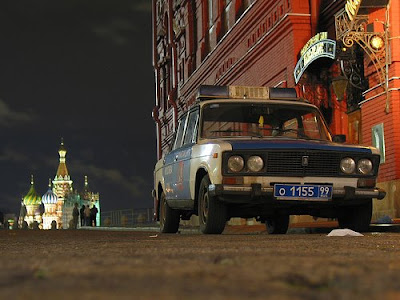
I am not surprised to see policemen smoking, buying hotdogs, eating sweets and flirting with girls when they are in uniform and on duty.


... more

Tuesday, 16 June 2009

Polittechno

A friend of mine recently introduced me to Polittechno, a genre of music dreamt up by Petersburg-based musician/producer, Alexei Vishnya. The name, 'Polittechno', comes from a compound of the words 'political' and 'techno' and consists of putting politicians' words to techno beats. You're more than likely to have seen Vishnya's most famous clip, 'Kto mog by byt' Prezident' (Who could be President), doing the rounds on You Tube, but there is much more where that comes from.


Vishnya, a sound director who produced about half the albums of legendary rock group Kino, started experimenting with politicians' voices back in 2000, after hearing a news presenter talking about Putin: I was watching TV, listening to journalist Sergei Dorenko, when he said: “Putin and only Putin.” I thought to myself, “that's rap” and started experimenting with famous people's voice, putting them to music. My first song was called “Putin and Only Putin”, with Dorenko performing as lead singer.

Four years later, Vishnya released an album, “Viagra for Putin”, showcasing all the good and great of Russia’s political glitterati: Putin, Zhirinovsky, Gorbachev, Chubais and Irina Kharmada amongst others. Of the 11 songs on the album, my favourites are ‘Russian Pigs’ (see below) and ‘Who’s Boris Berezovsky?”, feat. V.V. Putin, in which Putin disses the disgraced Russian oligarch, currently residing in London despite repeated Russian requests for extradition.


Russian Pigs, featuring Irina Khakamada and Vladimir Zhirinovsky
Essentially Zhirinovsky talk about 'Russian Pigs' - drug addicts, prostitutes, alcoholics and disabled people(?) etc., amongst others. To which Khakamada replies: 'Vladimir Volfovich, you are a coward.' The two argue then argue throughout the song, as Zhirinovsky's accusations of who exactly is a Russian Pig become even more all encompassing: all opposition parties, Americans etc.

Vishnya claims to have no real political agenda, calling his political subjects ‘muses’, responsible for inspiring musical creativity rather than political expression. When asked in a recent interview about his attitude to the Putin-Medvedev tandem, he replied: As philosophers say, I experience total objectivity towards these people – they exist outside my consciousness. Towards the Putin-Medvedev tandem, I am also entirely objective… As regards Putin, I have been observing him for a very long time now – even as far back as when he worked for the Communist party in what was Leningrad. However politics really didn’t interest me at all during the 1990s… Then at some point it became impossible to ignore politics any longer The informational field became so multifaceted that the muses from this sphere came themselves to visit me. I’m sure you understand how funny it is to observe them, their laughability and all their ridiculous pre-election debates.

And what do the ‘muses’ feel in relation to puppet-master Vishnya? His videos attract a lot of attention which can come accross as either positive or negative PR. Vishnya related a story to the newspaper Izvestia about how Irina Khamada invited him to Moscow following her starring role in Viagra for Putin. On one of the songs, entitled Techno Woman, she sings, "I met the president and I gave it to him. This isn’t our first year in politics and we’ve been around." To which Putin replies, ‘She’ll no longer be any one’s political toy.’ According to Vishnya, Irina praised the song as ‘funny’ and described him as a ‘talented boy’ (he was 39 at the time!) but when he suggested she collaborate with him on further songs she retorted: “I’m not a little girl – I’m a representative of the state Duma!”

Although he is yet to release another CD, Vishnya remains prolific, regularly posting new videos on his You Tube channel and on a Live Journal blog. His most recent post, which stars President Medvedev singing about the stability of the Russian political system, has already been viewed almost 6000 times. Nevertheless, despite his popularity, the money is not rolling in - his music (including his album) remains a non-commercial project, distributed for free on the internet : "the fanatical project of a man who’s gone crazy for politics."


The album in it's entirety, if anybody is interested.


... more

Sunday, 14 June 2009

Hello, Officer

Photo: einarorn on flickr.com
Yesterday I had my first run-in with the Russian police. Unlike many of my other foreign friends, I am not routinely stopped and hassled for my documents so this was my first direct experience of the renowned MVD, although of course I’d heard thousands of stories about how corrupt the Russian police are. This time around, however, I was definitely in the wrong, although I’m not entirely sure to what extent the police were in the right either.

Picture the scene. It was the start of a long sunny weekend and some friends and I decided to buy some wine and have a little drink in a park in the sunshine. Now, usually you can drink pretty much anywhere, anytime in Saint Petersburg, however we somehow hit upon the idea of taking our wine to the Summer Gardens, one of the few places where it is strictly forbidden to drink alcohol. We sort of knew it was forbidden, but this being Russia, where rules are made to be broken, we decided we’d probably be alright. So, we found a nice bench and after finding the requisite pieces of paper on which to sit (Russians have a peculiar horror of dirt and who knows what sort of diseases lurk upon benches) we poured our wine into plastic cups and started our evening. All was going swimmingly until a couple of policeman with joy in their eyes, descended upon us, shouting “you’re nicked!” (or at least the Russian equivalent).

Your Documents, Please

I suspect that the first lesson taught at Russian policeman school is how to ask for the documents of any law-transgressing (or potentially law-transgressing) (or indeed not Russian-looking thus potentially law-transgressing) character. It is perhaps the average Russian policeman’s favourite activity and they are at it everywhere: in the metro, on the streets, in the park, you name it. And so, true to form, we were asked to hand over our passports.

Not really wanting to do so, my Russian friends all immediately claimed not to be carrying theirs, whilst I stood there smiling stupidly, not having my passport with me and not really wanting to give away that I wasn’t Russian. The police, however, were adamant. No documents were produced at this point but we were told that it would be necessary to go with them to the station, to sort out this little problem. The police seemed remarkably happy about all this and didn’t in the least insist that we should pour the wine away. Instead, as we set off towards the station they told us to bring the wine with us, and so we we walked through the park drinking our illegal wine in their presence. They were also very cheerful, joking away as if it was all part of the picnic.

When we arrived at the station – a small hut/office in the park boundaries – we were told we would have to show our passports. In gallant, Russian-man style, my friend assured the police that the devushki (girls) hadn’t been drinking and so it really wasn’t necessary. Alas, the fact we were holding cups of wine somewhat negated this and the policeman insisted we show them. At this point I had to admit that I wasn’t Russian and unfortunately didn’t have my passport. To which the policeman astutely replied: “And how do I know you’re not a foreign terrorist?” Good question, to which I had no proof illustrating the contrary. He seemed to accept my promise that I wasn’t, but all the same made us go into the little hut, where a matriarchal mama of a policewoman sat looking at us severely.

“You do realise you are not allowed to drink in this park?” the woman asked. Well, yes. And then, the horrible fate that surely must arise from a meeting with the Russian police after such unlawful activity never happened. “Devushki, you must read these rules and then you can wait outside on the benches.” This was clearly a man's problem. And so Anna and I dutifully read the Park rules (which somewhat bafflingly included ‘no killing of swans’ despite a notable lack of swans in the park) and then went outside leaving the men to do their stuff. The men were offered a choice – 500r official fine per person, including noting down of passport information, or 300r under-the-table, straight in to the policeman’s pocket. A no-brainer really. The boys paid up as the girls waited quietly outside.

All’s Well That Ends Well

And so our police escapade ended. I learnt a few important things about how the police in Russia work: first, they really do love that little bit of money. The system of slipping the police a couple of hundred roubles and avoiding any further trouble is so entirely engrained in the minds of both the police and Russian citizens as to make it an almost officially sanctioned law. Second, when there’s a promise of some money the police are friendly. I mean, really, really friendly. Third, the Russian police are rather sexist. And for once, I was glad of it!


... more

Thursday, 4 June 2009

Mr Medvedev

Art Work: Jose Maria Cano Photo: EFE/Sergei Chirikov
I went on a little jaunt last weekend to the wilds of the Russian countryside in search of bears, but alas my search was not very fruitful. Fortunately, my disappointment was curbed when I got home and found my news feed full of little tales about that other Russian bear-related character: Mr Dmitry Medvedev. I do like a good presidential story and here are some of the best from last week.

Why Women Love Medvedev
A recent survey by the “Social Opinion” foundation (FOM) has shown that Medvedev’s approval rating amongst women has risen by 10% over the last two months, giving him an overall 67% approval rate amongst the fairer sex. FOM put the question, “How do you think the president has changed over the past year” to women across the country, receiving amongst it’s replies, that: the head of government has “become more decisive” and “demanding”; “he has matured to become more competent”; “he is more active and business like” and some women even noted that his exterior appearance had changed. All in all, the consensus was that Putin’s protégée has grown up, at last adequately filling the presidential shoes. He might not have his prime minister’s good looks, but as political poster boy number two, Putin should start watching his back.

According to psychologist Sergei Makelov, the reasons for Medvedev’s increased popularity are quite obvious. “Most woman like an action-man type of character”, he told popular newspaper Argumenti i Fakti, “the kind, who is capable of solving any problem – or, at least claiming to be able to, since to the female ear the two are one and the same.” [whaaaat?] Apparently, Medvedev’s resolute pronouncements on education, healthcare and the ongoing struggle with wayward provincial bureaucrats have won him over the female electorate. Whether he follows his promises through remains to be seen, however, according to Makelov, this part of the bargain is not so important to women anyway. What a wonderful position for a politician to find himself in!

Mummy, I’ve Painted Medvedev


Over at Russian Livejournal (the place to blog in the Russian Federation), blogger fima-psuchopadt writes of a bumper-crop of children’s drawings that he has stumbled across, depicting respected Dmitry Anatolevich Medvedev himself. Now, I know traditionally Russians have always gone in for cult-building around its leaders (the proliferation of Lenin statues and Stalin's cult barely need mentioning here, although the tradition actually stretches back to Tsarist times) but in this day and age, I was a little surprised to learn that primary school children had been painting their president. Is this usual behaviour? (Side note: in the primary school I teach in there is a large picture of Dmitry Anatolevich over the door. Lovely stuff)

To return to fima-psuchopadt’s post, he has selected some of his favourite entrants amongst the art works, which he, somewhat ironically, sees as an uncanny representation of Russian truth, as depicted through childish eyes.


1. Medvedev frolicking past the three essential stages of a Russian's life: school, university,and, erm, Gazprom. As firma-psuchopadt points out, Medvedev is interestingly positioned so as either to be going backwards or leading a song and a dance on the spot. Uncannily indicative of the direction of Russian politics?


2.
“Medvedev Reads the Constitution to Children”. Apparently a wonderful example of respected Dmitry Anatolevich's greatness – note how even the cat and dog look upon the mighty president with rapt attention. However FP spots a bit of anti-state feeling in the over accurate attention to Medvedev’s diminished height and oversized tie knot.

That’s all on the weekend’s bear spotting, but there’s sure to be more soon.


... more

Saturday, 30 May 2009

I live in Russia!

Picture: Film Poster for "Molodaia Gvardia"
Now the big raving Brit in me means that I have rather mixed feelings about England being dissed, especially when it includes having accusations of bourgeois-imperialism levelled at me. However, when it’s in a catchy song endorsed by a pro-Kremlin youth group and sung by one of Russia’s most notorious chanson artistes then I guess I can let it lie. “Ya zhivu v Rossii!” (I live in Russia!) is the latest single out by Sergei Trofimov and rather popular on the Molodaia Gvardia youth movement website. It won me over, see what you think:


(You can read by (very badly translated) transcript of the lyrics in English below. If anyone can do any better you are more than welcome!)

Somewhere in London it’s been pouring with rain since the morning
Pavements, streets worn out by cabs
You won’t find any place in the pubs, and on the stock exchange,
The game turns into the usual British gambit

The order of things here is unchanging and simple
Like the parliamentary throne of the Queen
And the influential pound continues the rise
Of the bourgeois-imperial tree

*** Chorus ***

But I live in Russia!
At the furthest point of being
I live in Russia!
It’s simply my motherland

In this untamed great power
Constrained by dreams of days gone by
It’s unlikely that life will become more substantial or simpler
But it’s my home

***

On the Saint-Claire Boulevard chestnuts are flowering
And in the Boulogne forest the cold wind has gone astray
And the glass turns red from Burgundy wine
As if the Holy Grail has been discovered again

Here a united people respect themselves
And their freedom attained through suffering
And they live from day to day, not bemoaning anything
Earning a profit from goods from year to year

I had a friend, he went away a long time ago
To that place which did not have shocks and misfortune in store
For him, our life is like a bad film
Where the budget can’t save the mediocre plot

Sometimes he calls to find out how things are going
And, having heard the latest gossip
Doesn’t understand why we are burning to the ground
In order to once again rise from the ashes


... more

Friday, 29 May 2009

News from the Caucasus

Photo: Sergei Maximishin, Kabardino-Balkaria
Russia is the biggest country in the world. Fact. And it’s with this in mind that I’m going to start blogging more news from the more far flung regions of the motherland. In the days to come I’ll be taking a look at the Russian Far East, Siberia, the Urals, who knows - I might even make it to Murmansk. But for now, I’ll start where I left off on Wednesday – down south, in the Caucasus.

Kavkaz-uzel.ru is an internet news portal for the Caucasus region with constant updates on breaking news stories. I read through the news posted over 24 hours yesterday and picked out 3 stories to tell you about.
___________________________

A Gun Battle has Broken out in the Capital of Kabardino-Balkaria
May 28, 3:35am

The sound of explosions and gunfire can be heard in central Nal’chik, capital of Kabardino-Balkaria, near to the central market and bus station.

“Law enforcement officers have blocked militants into a privately-owned building on Mechnikov street,” explained one source.

The shootout in central Nal’chik started at 1:30am Moscow time. At the current moment single gunshots can be heard.

The situation in Kabardino-Balkaria has again escalated. On the night of the 10th of May in the village of Dugulubgia after a special operation by the FSB three fighters were killed. According to unofficial sources, one of those killed was later identified as a former Imam of the Kabardino-Balkarian Jamia, Mussa Mukozhev.

On the 14th May the vice chief of the pre-trial detention facility of the federal penitentiary service Vitalii Bogatyrev was shot dead nearby his home and 500m from his workplace, by a gunman in a passing vehicle.

On the 20th May in Nal’chik gunmen opened fire on traffic policemen in a police car. The policemen returned fire but the gunmen managed to get away.

****

Markov: strengthening Abkhazia’s border with Georgia will ensure security
May 28, 9:11am

Reinforcing the border between Abkhazia and Georgia with Russia border guards will allow a higher level of security for Abkhazia to be ensured, will improve the economy and raise the number of tourists to the region declared Sergei Markov, MP.

According to the Markov, the Georgia’s government, under President Mikhail Saakashvili “has not let go of the idea of bringing Abkhazia back under control by force.”
The agreement signed on the 30th April to guard the border between Abkhazia and Georgia with both Abkhazian and Russian border guards is “legal, obvious and expresses the interest of the peoples of Russia and Abkhazia” declared Markov. “The border guards not only guard the border but also create the conditions for peaceful work and development of the people of Abkhazia.”

On the 1st May NATO declared that the agreement with Abkhazia and South Ossetia on guarding their borders is in conflict with the agreements from the 12 August and 8 September and is not conducive to long-term peace and security in the South Caucasus.

Markov also mentioned that he had been involved in the preparatory stages of a expert-youth forum that will take place in Abkhazia in July with the participation of “United Russia” [Russia’s ruling party], “Young Guard” [a pro-Kremlin youth group], students and professors from Russian universities and Russian experts.

****

Preparations continue in Chechnya for the municipal elections
May 28th 2009, 13:34pm

Preparations for Chechnya’s municipal elections which will be taking place on the 11th October are currently underway. They are being taken particularly seriously due to the fact that this is the first time that municipal elections are being held. The regional Central Election Committee is undertaking a lot of work preparing brochures as well as seminars to ensure that voters, candidates and the media understand the election process.

Observers have expressed scepticism with regards to the results of the voting in the parliamentary elections that took place on the 12 October 2008. What bothered them in particular was the unconditional support shown by the population towards “United Russia”, the leading party that received 88.4% of the votes.

Meanwhile, the voting situation for two contested regions remains unclear. Sunzhenskii and Malgobekskii are currently under the jurisdiction of Ingushetia, but before 1934 were administrative parts of Chechnya. Chechnya’s head of parliament has previously made clear that the status of these regions need to be decided in a fair manner. However, there are no documents other than those from 1934 that determine whether these two regions belong to Chechnya or Ingushetia. Official commissioner on Human Rights to the Chechen Republic Nurdi Nukhazhiev has also declared that Ingushetia does not have the right to lay claim to Chechen land. Nevertheless in recent times the question as to the status of Sunzhenskii and Malgobekskii has not been raised.


... more

Wednesday, 27 May 2009

Hotting up down South

Photo: Sergey Maximishin

Since President Dmitri Medvedev triumphantly declared the end of the anti-terrorist operations in Chechnya last month, leading the republic’s leader Ramzan Kadyrov to envisage a bright future of foreign investment and economic growth, things in the Causcasus have gone a little bit iffy – it might not yet be quite time for a summer break in Grozny. Over the past month or so the daily news has been highlighted by intense gun battles between the military and the “bandits”, who have been hiding out in the forests of Dagestan or involved in shootouts in the capital of Ingushetia.

According to Vladimir Mukhin of Nezavisimaia Gazeta, despite attempts by the southern republics’ leaders to give the impression that everything is under control by underestimating the numbers of “bandits” participating in battle, the numbers of terrorists killed or detained recently as reported by the Ministry of Internal Affairs tells a different story. According to official figures, since the 16th of May, when anti-terrorist operations in the regions were stepped up, 28 bandits have been killed and more than 20 detained. Around 12 members of the Ministry of Internal Affairs have been killed. The Ministry of Defence stopped publishing figures for its members killed in Chechnya last year and so the final tally of law-enforcement victims is uncertain, but nevertheless the situation is considerably more serious than the leaders of these regions would like to admit.


... more

Tuesday, 26 May 2009

Sunday, 24 May 2009

Meet the Gopniks

Photo: okya1.ru
A group of young men wearing pointy-toed leather shoes, gold chains and shiny tracksuits with fake brand names – think Abibas not Adidas - squat around a mobile phone that blares out Russian techno, chewing on sunflower seeds, drinking beer and occasionally spitting massive gobs of phlegm to display their manliness. Meet the Gopniks, a so-called youth sub culture (although no one would ever actually describe themselves as a gopnik) of young, not-very-well-off, Russian men.

It is impossible to live in Russia very long without hearing about the gopniki: newspapers, blogs, even my friends, talk constantly about them, but exactly who they are is a bit of a mystery to me. Gopniki.net , an online ‘museum’ of gopniks providing a cod-anthropological expose of the group, gives the impression that they are a defined criminal group, whilst another site describes them as 'a post-Soviet subculture educated in the criminal aesthetic and brought up in a working environment.'

And yet my friends' use of the word 'gopnik' is far wider: anyone from the working classes, who seems to be getting a bit lairy or causing a bit of a trouble can be classed as a gopnik. Could it be that gopnik is the Slavic equivalent of the British chav? Is that even possible in Russia, a country which apparently doesn't sh
are Britain's complex system of class snobbery, as epitomised by the much-debated division between chavs and chav-nots?

The exact origins of the term ‘gopnik’ are unclear, although it is generally agreed that it comes from the addition of the suffix –nik to the acronym GOP. However to exactly what GOP refers remains a contentious issue. One version has is that it stands for Gorodskoye Obshchestvo Prizreniya (the City Society of Care), the name for the network of poor houses set up by the Soviets following the October Revolution. Another version translates the acronym as Gorodskoye Obshchezhitiye Proletariata (The City Hall of Proletarian Residence), referring to a large hostel set up in the 1920s in Saint Petersburg in the Hotel Oktyabrskaya, to house the tidal wave of peasants and small-city dwellers that flooded into the capital during the chaotic dislocation of the post-revolution years. According to Petersburg folklore, the once-grand hotel soon became became renowned as a hubbub of criminal activity although historians have never been able to find proof of it’s existence.

In any case, whichever acronym GOP refers to, the term gopnik evolved as a word to describe poor young men, whose backwards ‘provinciality’, criminal behaviour and general loutishness conflicted with Soviet rhetoric, which called for ‘culturedness’ - a value reaching far beyond our western perception of culture, encompassing certain standards of behaviour such as abstinence from alcohol, traditional sexual morals and a smart and clean appearance. Throughout the Soviet years, the term gopnik was invoked as an insult to those on the margins of society, who drank, committed crime or were just generally considered uneducated and uncultured.

The term gopnik survived the collapse of the Soviet Union and throughout the 1990s it evolved to refer to the hard men who reigned throughout this lawless period – the reason why most Russian flats have at least three locks, as gopniki, shaved-headed heavies provided the muscle in business and politics. During the 1990s gopniki had power, if not respect, as they raked in money by any means as many, more educated Russians suffered from the fall out of the Soviet Union and the difficulties of adjusting to the free market.

With the demise of Yeltsin and the implementation of Putin’s iron hand and with no strong cultural yardstick a la Soviet culturedness, it looked as though Gopniki as a social subgroup could be over. Indeed, when a couple of years ago a group of journalists from Exile magazine went on a ‘gopnik’ safari they concluded that the gopnik movement was as good as over: Just as the mighty Tyrannosaurus Rex evolved into the rock pigeon, right before our eyes we're witnessing the rapid devolution of the gopnik into something that can only be described as "skinny dude with a bad mullet who tells everyone he's a brand manager but for now he works at a Evroset kiosk where he managed to five-finger enough cash to get himself a used Nissan Almera, which he loves more than anything which ever was, is, or shall be." And so from a feared group of fairly hardcore criminals, the gopniki have become a mocked group of not-very-wealthy Russians. Gopnik has become a cult idea, spawning books, music, the works... Take a look at this clip by Syava, a rapper who parodies ‘Gop Hop’ artists (think Goldie Lookin’ Chain meets the Russian Provinces) a current you tube sensation.

The label ‘gopnik’ is assigned to anyone of low income and low education, who, in the eyes of society, don't have the nouse to sieze the opportunities available to them in society. Today's Russian gopniks are no different to England’s chavs or America’s white trash: they are not a cultural sub group – indeed, they can not even be defined as one group - but a reflection of social snobbery very much alive in Russia today.


... more

Thursday, 14 May 2009

News from the Eastern Face


I'm going to be posting Radio Free Europe's "This Week in Facebook" every week now. For anyone who's interested in following events in countries of the former Soviet Union RFE's website http://www.rferl.org/ has got tonnes of information, much of which you cannot find elsewhere in the press.


... more